Engineers are available to assist.

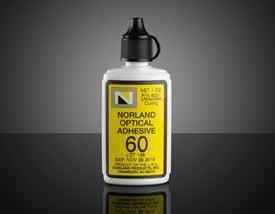
1 oz. Application Bottle of NOA (NOA 60 shown as an example)
| Volume Pricing | |
|---|---|
| Qty 1-4 | €39,50 each |
| Qty 5-11 | €35,60 each |
| Qty 12+ | €33,90 each |
| Need More? | Request Quote |
Norland Optical Adhesives are clear, solvent-free optical adhesives designed to fully cure in only minutes when exposed to ultraviolet light. These adhesives are used in precision alignment or positioning applications that require a robust and resilient bond. Norland Optical Adhesives feature a variety of bonding types, including but not limited to glass to glass, glass to glass/metal, and plastic to plastic/glass. To use Norland Optical Adhesives, apply the adhesive to the optical surface, position the components, and use a UV light source to set the components in place. Since the adhesive will not cure until exposed to UV light, time can be taken during the positioning process to perfect product alignment.
Norland Optical Adhesives are clear, solvent-free, one-part adhesives designed for precision optical bonding applications requiring excellent optical quality and a durable, low-stress bond.
These adhesives cure rapidly when exposed to UV light, gelling in seconds and fully curing in minutes, which allows users to precisely align lenses, prisms, filters, and other components before initiating cure.
They are widely used in photonics and optomechanical assembly for bonding glass-to-glass, glass-to-metal, and glass-to-plastic interfaces where fast, controlled positioning is critical.
Standard UV-curing formulations provide long working time since the adhesive remains liquid until exposed to UV, enabling high-precision alignment and simplified assembly workflows.
Select formulations with an “-H” suffix incorporate a secondary heat cure mechanism, allowing the adhesive to fully polymerize in shadowed areas or through opaque substrates where UV light cannot reach.
These heat-curable adhesives typically use a latent thermal catalyst (e.g., ~125 °C cure) to complete the cure and achieve maximum physical properties after initial UV fixation.
For product usage, apply the adhesive, align components, use UV light for initial set, and apply heat when required to ensure complete cure throughout the bond line, especially in complex geometries.
Important technical considerations include selecting the appropriate refractive index and bonding compatibility, as well as accounting for oxygen inhibition in heat-curing (-H) grades, which may require inert atmosphere curing for exposed surfaces.
| Norland optical adhesives (NOA) application notes | |
| Title | Description |
| Applying Adhesive | Covers best practices to use when applying Norland Optical Adhesives to ensure an even adhesive layer while avoiding air bubbles. |
| Chemical Resistance of NOA | Covers the effects of various chemicals on Norland Optical Adhesives including acids, bases, and solvents. |
| Preventing Lens Separations with NOA | Covers best practices to avoid adhesive failures when bonding optical elements. |
| Separating Lenses Bonded with NOA | Covers how to unbond optical elements bonded with Norland Optical Adhesives. |




or view regional numbers
QUOTE TOOL
enter stock numbers to begin
Copyright 2025 | Edmund Optics BV, De Maas 22B, 5684 PL Best, The Netherlands
California Consumer Privacy Acts (CCPA): Do Not Sell or Share My Personal Information
California Transparency in Supply Chains Act
This content may include material that has been generated or modified using artificial intelligence (AI).
The FUTURE Depends On Optics®